AI Tools / Claude Code
Independent overview · No affiliate links
 Claude Code
Anthropic's coding agent. It reads and edits files and runs commands from your terminal or editor. It is included in paid Claude plans, and usage is shared with the Claude apps. Most of our production automation runs on it.
Official site ↗
- Best known for
- A terminal and editor agent you hand multi-file tasks to and then review
- Billing model
- Included in a Claude plan (five-hour and weekly limits) or billed by API usage
- Cost per 1x of weekly usage (our math)
- $20 on Pro, Max and Ultra alike
- Responses per human message (our log)
- 14.3 on average
- Free plan
- Claude Code is not included
- From our market map
- $2.5B+ run-rate revenue (Reuters, 2026-02; marked △; no newer product-level figure is public)
What this tool does
Claude Code is an agent you hand work to, not an autocomplete that helps you type. You describe a task, and it reads and changes files, runs commands and reports back. The terminal, editor extensions, desktop app and web version share one engine, so project instructions and connected services carry across them. The real choice is less about which screen to use than about how much after-the-fact review you are prepared to take on.
Cost is where it is easiest to go wrong. One instruction is not one request: each tool call sends another request carrying the conversation so far, so a short question in a session left open all day draws usage for the whole history. That is why limits can shrink faster than your activity suggests, and why clearing the session between unrelated tasks does more than writing shorter prompts.
Its use also reaches beyond programming. Our video production and site maintenance run on it, and most of that is file handling, scripts and checks rather than application code. That use made its weak point clear: it is better at carrying out a long sequence than at judging whether the result is right, so the cost of checking does not go away.
Our hands-on notes
- We have used it for editorial work since September 2026. We started on the $100 plan and moved to the $200 plan 11 days later (prorated $133.80, 2026-09-18). During a period of producing two episodes at once we ran two accounts.
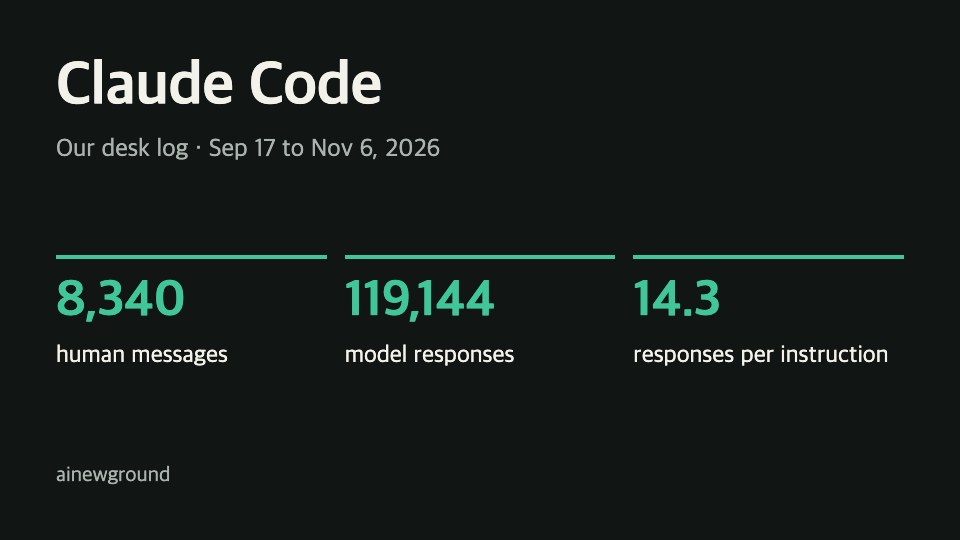
- Logs in this working folder (2026-09-17 to 11-06) show 8,340 human messages, 119,144 model responses and about 89.07 million output tokens: 14.3 responses per instruction on average. Old logs are deleted automatically, so the true figure may be higher.
- Two $200 subscriptions spread over 150 shorts a month came to about KRW 3,700 per short (2026-10-07). That matches the median video and voice cost of KRW 4,034, so the subscription was not a small part of unit cost.
- We keep rules in 226 memory files (2026-11-06) so the next session can pick them up. Even so, sessions have reported work as finished when it was not, so we added a separate rule to re-check numbers and files before reporting.
- Several sessions in one folder will touch each other's files. Commits picked up other sessions' changes, so we now commit by explicit path only. Three sessions running a heavy transcription job at once also stalled for 25 minutes (2026-10-08).
- Auto mode blocks commands it judges risky. On 2026-11-06 it blocked a call using a service account key meant for another purpose, and the registration of an always-on background job. Such steps need a person or a different approach.
- Disclosure: this card was drafted with Claude, an Anthropic model. For that reason it makes no claim that Claude Code beats other tools, and its numbers were compared with official pages and our own records.
- Checked: on 2026-11-06 we re-read the official pricing page, the Claude Code cost documentation, the plan usage help article, the Max article and the consumer terms.
- Not checked: in-app pricing, the final Korean charge with tax, the absolute size of the five-hour and weekly limits (not published), and how limits feel under the current plan names. We have not used Team or Enterprise.
Who it fits
Developers handing off multi-file work
Test writing, dependency updates and conflict resolution suit it, because a command can check the result without you reading every line.
Solo operators with repetitive file work
As our video production shows, you do not need an application to delegate scripts, file checks and document upkeep.
People already paying for Claude
It is in the same plan, so trying it costs nothing extra, though it shares one allowance with the apps.
Teams that want shared rules
Instructions and permission rules can live in the repository. We have not used the Team plan, so this rests on the official docs.
Anyone running long unattended jobs
The lifted five-hour limit on verified Ultra pays off most here. The weekly limit stays, and a temporary limit may apply.
Who should skip it
- Buyers who want a fixed amount of work for a fixed price. Limit sizes are unpublished, so you cannot work out how many tasks a plan buys.
- Anyone who cannot review the output. It can change and delete files on your machine, so someone has to notice when a report is wrong.
- Light chat users. The official guidance says one debugging session can use more than a day of chat.
Core features
Permission modes
Six modes, from asking each time to no prompts. Auto mode swaps your approval for a classifier, which the docs say does not guarantee safety; 3 blocks in a row or 20 in total return it to asking.
CLAUDE.md and auto memory
Loaded at session start as context, not enforced rules. Only the first 200 lines or 25KB of the memory index load, and memory stays on one machine.
Hooks
Your own commands run before or after an action and can block it whatever the model decides, but you must script them.
Subagents and agent teams
Long output stays out of the main conversation, yet still draws on usage. Teammates in plan mode use about 7x the tokens of a standard session.
Scheduling
Cloud tasks run with your computer off but see only a fresh clone, and are in research preview. Desktop tasks need the machine on. /loop needs an open session; recurring tasks expire after 7 days.
/usage breakdown
Shows what consumed your limits, but from that machine's history only, so other devices and claude.ai are left out.
Usage credits
Continue past a limit at standard API rates. With no monthly limit set, the row reads Unlimited, so set one before overnight automation. The only route to Fable on Pro.
How we actually run it
Turn corrections into files
Each correction becomes a topic note with one line in an index. The index stays inside the loading limit at 110 lines and about 17KB (2026-11-07); detail moved into the notes in October.
One job per session
Each episode or application gets its own session. Research with many primary sources goes to a subagent, usually with a 15-minute cap and a progress line every five minutes, after a silent 13-minute run looked like a stall.
State the write scope
Briefs forbid writing outside the assigned folder. A conversion script once overwrote 808 text files from other episodes, and 8 could not be restored (2026-10-05).
Lock shared resources
Paid generation submissions and 4K renders need a shared lock. Overlapping submissions from one account were flagged as unusual activity by an outside service (2026-10-02).
Write last when editing
Scripts read, check the result, then write. Opening a file for writing before the check emptied shared documents twice in October.
Run new jobs with someone present
A first-time approval prompt was rejected after five minutes in an unattended run, leaving that day's job empty (2026-10-10). First runs now happen while someone watches. In-session schedules get re-registered each Friday.
A person finishes
Publishing, final submissions and invoices are done by a person. Sessions prepare the confirmation card and the material.
Claude Code pricing
Free
- Claude apps only · no Claude Code
Pro
- 1x usage per five hours and per week
- Annual billing is $200 up front (about $17 a month); tax extra
Max
- 5x Pro per five hours and per week
- Monthly only · $100 a month in API credits (not usable in Claude Code)
Ultra
- 10x Pro per week · no five-hour limit for verified accounts
- $200 a month in API credits (not usable in Claude Code)
Team standard seat
- 2–150 people · per seat
- Premium seats are $125 a month ($100 billed annually) with 5x usage
Pricing checked 2026-11-06 · Official pricing page ↗
Checked against the official pricing page and help articles. Prices are in USD before tax. The plans once called Max 5x and Max 20x are now Max and Ultra, and the $200 plan now lists 10x Pro weekly usage. Do not rely on names or multiples in older articles; check at checkout.
Strengths
- Reading, editing and running commands happen in a single flow
- One subscription covers both the Claude apps and Claude Code
- The same account works in the terminal, VS Code, Cursor and JetBrains
- A small capped allowance lets an in-progress response finish at a limit (rolling out gradually)
- The /usage command shows how your limits were consumed
What to consider
- If the ANTHROPIC_API_KEY environment variable is set, Claude Code authenticates with that key instead of your subscription and API charges apply. Subscribers should check this first.
- The monthly API credits on Max and Ultra ($100 and $200) cannot be used in Claude Code or the Claude apps, so do not treat them as a rebate on the subscription.
- Limits are shared with the Claude apps, so heavy daytime app use stops overnight automation sooner. Fable has its own cap of half the weekly limit.
- One times Pro weekly usage costs $20 on Pro, Max and Ultra alike. The higher plans' value comes from looser five-hour limits and priority access rather than a volume discount.
- Subscriptions renew automatically, and you must cancel at least 24 hours before the term ends to avoid the next charge. The default under the terms is no refund; residents of South Korea may withdraw within 7 days of signing up, though usage so far may be deducted.
- The official docs put the enterprise average at about $13 per developer per active day and $150–250 per month. With automation this is only a rough guide, since costs vary widely by usage.
- The model can report wrong work as correct. Keep a human approval step for hard-to-undo actions such as payments, deployments and deletions.
Alternatives
- OpenAI Codex — Pick Codex if you already pay for ChatGPT or want a cheaper start: it has a limited free tier and Go at $8, while Claude Code starts at $20.
- Cursor ↗ — Pick Cursor for a code editor first: Plus at $8 is Grok-only; other vendors' models need Premium at $30 and bill at API list price. Not in our records.
FAQ
How much does Claude Code cost?
On the official pricing page checked 2026-11-06, Claude Code is included in Pro at $20 a month ($200 a year), Max at $100 and Ultra at $200. A Team standard seat is $25 a month ($20 billed annually). Tax is extra.
Can I use it for free?
It is not included in the free Claude plan. Without a subscription, you can add API credits to a Claude Console account and pay for what you use.
Which plan should I pick: Pro, Max or Ultra?
Each costs $20 per 1x of weekly usage, so there is no unit price difference. Start with Pro for a few hours a day, look at Max if the five-hour limit keeps stopping you, and Ultra for long uninterrupted automation. The absolute limits are not published, so measure your own.
What about rights and commercial use of the code?
You are responsible for the prompts and actions you submit, and the consumer terms apply to individual plans. For company work, check which terms apply on Team or above. This is not legal advice.
How do cancellation and refunds work?
You can cancel at any time and keep access until the paid term ends. Cancel at least 24 hours before renewal to avoid the next charge. The default is no refund, but South Korean residents may withdraw within 7 days of signing up, and usage may be deducted.
What happens at a usage limit?
Wait for the reset, enable usage credits or move to a higher plan. You can also switch to API credits on a Console account. The official docs say warnings appear as you near a limit.
How does it differ from Codex or Cursor?
All three take on coding work, but the subscriptions differ: Claude Code comes with Claude plans and Codex with ChatGPT plans. We have records for both Claude Code and Codex on different kinds of work, so we have not measured which is better.
Why does this card not describe how the limits feel?
Plan names and limit labels changed during 2026, and our records use the old names. We left this out rather than print figures that cannot be compared.
Our verdict
It earns its price on work that a command, a file or a person's eyes can check. Start on Pro at $20 and move up only when the five-hour limit is what actually stops you. Count the effort of building guardrails as part of the cost: we have 226 notes and have still lost files. It did not remove review from our work; it moved review to the end of longer runs. We have not measured its code quality against rival tools, so this is a verdict on the way of working rather than on the model. Buy it for throughput on checkable work, not for judgment.
Similar tools

Logos and icons are trademarks of their companies, shown only to identify each tool. They do not imply affiliation or endorsement.
How we built this card
- We re-read the official product and pricing pages on 2026-11-06.
- For tools our desk uses, we record the plan, period and numbers; for tools we have not used, we say so.
- No star ratings. This page contains no affiliate links, and every external link goes to the official site.
Sources: Claude pricing · Claude Code overview · Claude Code: manage costs · Use Claude Code with your plan · What is the Max plan? · Anthropic Consumer Terms of Service · AI 에이전트 업계 지도(ko) · AI agents market map (en) · Claude Code: permission modes · Claude Code: how Claude remembers your project · Claude Code: run prompts on a schedule · Claude Code: cloud scheduled tasks · Cursor pricing · Codex pricing