AI Tools / Qwen3-TTS
Independent overview · No affiliate links
 Qwen3-TTS
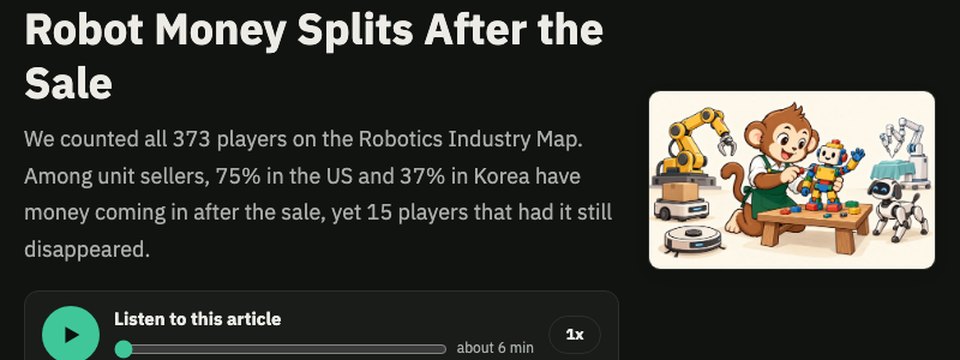
A speech synthesis model the Qwen team at Alibaba released under Apache 2.0. Run locally it has no fee, and the cost is your hardware and time. We use it on a Mac for the four-language audio of our robotics article and for course narration.
Official site ↗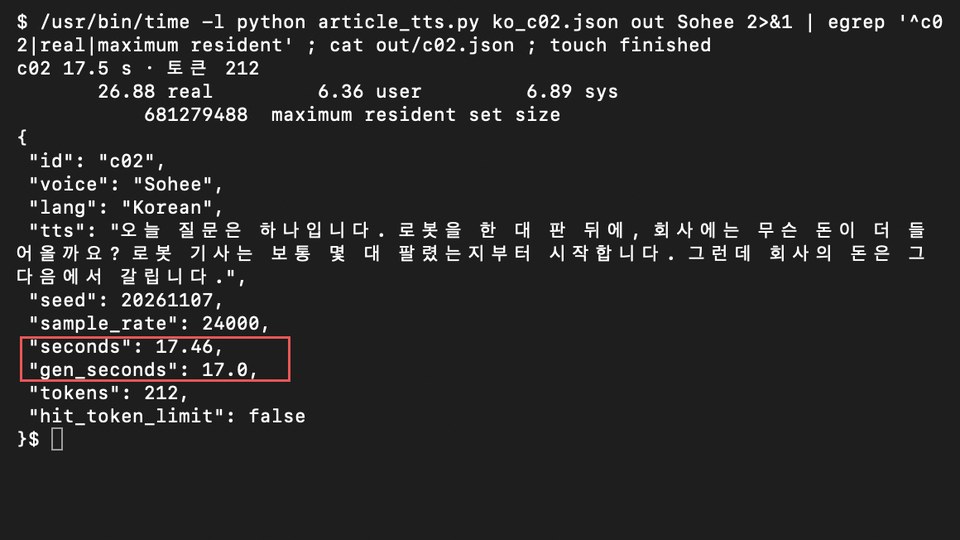
- Good at
- Local speech synthesis in 10 languages, with style instructions and voice cloning
- Billing
- Open weights are free; the API model qwen3-tts-flash is $0.1 per 10,000 characters (Singapore)
- License
- Apache 2.0; no trademark rights included
- Time on our Mac (measured)
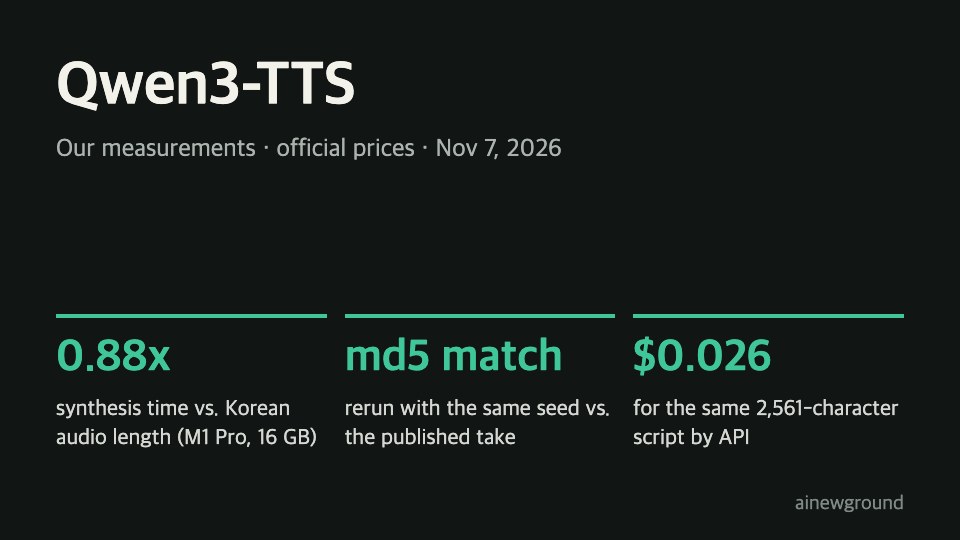
- 436.9 seconds of Korean audio in 383.2 seconds (0.88x), M1 Pro with 16 GB
- Same script by API (our math)
- 2,561 characters, about $0.026
- Native Korean preset voices
- One, Sohee (of nine CustomVoice speakers)
- Downloads and stars (2026-11-07)
- 1,517,422 downloads last month for 1.7B-CustomVoice; 14,253 GitHub stars
What this tool does
Qwen3-TTS is a model you download, not a service you join. Released on January 22, 2026, it comes as CustomVoice, which reads with preset speakers; VoiceDesign, which creates a voice from a written description; and Base, which clones a voice from a short clip. Sizes are 1.7B and 0.6B.
The name covers two routes, which is easy to confuse. The open model in the repository runs on your own hardware with no fee. Alibaba Cloud's qwen3-tts-flash is an API billed by character, and we found no statement in the docs that it is the same model as the open weights. Everything we measured on this page is the open model.
This page centers on the published audio for our robotics article. Money barely separates the routes: our 2,561-character Korean script would cost about $0.026 by API. The reasons to choose local are keeping the script on your machine and being able to reproduce the same result, more than the price. If neither matters to you, the API or a subscription product may be the simpler choice, and this page explains where each one fits.
Our hands-on notes
- On 2026-11-07 we used this model to produce and publish the audio of our robotics article in four languages. The speakers are Sohee for Korean, Ryan for English, Ono_Anna for Japanese and Vivian for Chinese. On the Mac we use mlx-audio 0.5.9 and an 8-bit converted model instead of the official package.
- The Korean script is 2,561 characters in 15 chunks. The first synthesis produced 436.9 seconds of audio in 383.2 seconds of generation (0.88x). English, at 5,594 characters, produced 395.9 seconds in 901.1 seconds (2.28x). We have no record of whether other jobs overlapped, so we do not conclude that English is inherently slower.
- Regenerating the first chunk with the same seed gave a wav whose md5 matched the published one (2026-11-07). Generation took 27.3 seconds for the published take and 17.0 seconds on the rerun. The sound reproduced; the time depended on the state of the Mac that day.
- The same seed does not hold a voice steady when the sentence changes. In a course, one sentence from the same speaker came out with a brightness of 3,461 Hz against a 2,551 Hz average in the earlier episode, and someone on our desk flagged it by ear. Since then we compare several seed candidates by the numbers and a person makes the final pick by ear (2026-10-22).
- An English speaker reading Korean can slip into English on a short word at the start of a sentence. For one such Korean sentence read by Aiden, which came out sounding like the English word "ease", seven of eight seeds were fine.
- In Japanese we reworked 6 of 15 chunks. Three had a 「・」 decimal point heard as 48% or 214%, so we changed it to 「点」. The number 177, a stray opening sound and a source count that kept coming out wrong also needed handling. Without the transcript check after synthesis, those misreadings would have shipped.
- Raw output has long pauses. Capping pauses inside a chunk at 0.30 seconds removed 79.0 seconds, and the finished Korean file is 5 minutes 54 seconds and 2.8 MB as mp3. The Korean transcript comparison scored 86.6%, but the script spells numbers out while the transcript writes digits, so this is not an accuracy figure.
- In one course lesson we synthesized 49 sentences, reworked and resynthesized 5 places where the transcript was unclear, then normalized notation and compared all 49. A full human listening pass was still outstanding at the time of that record.
- Checked: on 2026-11-07 we re-read the repository README, license, Hugging Face model page, Model Studio pricing, non-real-time synthesis docs and free quota docs, and regenerated the first chunk on an M1 Pro with 16 GB.
- Not checked: we have not used voice cloning, voice design, real-time streaming, the 0.6B models, the official package, CUDA or paid DashScope API calls, so we could not reproduce the official 97 ms latency or judge API quality. Process memory peaked at 681 MB, which may not reflect total unified memory use. There has been no native-speaker review and no real-phone playback test yet.
Who it fits
Small publishers adding audio to articles
There is no per-character fee however often you revise a script. One article in four languages took us about 36 minutes of generation time, not counting discarded retakes.
Teams that cannot send scripts outside
You can synthesize unpublished stories or internal training material without an external API. We load the model from a local folder, though we have not tested with the network fully cut off.
Course makers who must reproduce a voice take
Record the seed and settings and the same sentence comes back identical down to the file. You can fix one sentence and leave the others untouched.
Solo creators producing several language editions
Four language speakers sit in one tool and one order of steps. You still have to fix things like number reading separately for each language, as we did for Japanese.
People who already own a 16 GB Mac or a GPU
Our model folder is 3.2 GB and we ran it on an M1 Pro with 16 GB. If you would have to buy hardware for this, the price comparison flips.
Who should skip it
- Real-time conversation such as phone support: the official 97 ms figure is for streaming, a route we have not used, and whole-script synthesis on our Mac took 0.87 to 2.28 times the audio length depending on language.
- Choosing among many Korean voices: only one of the nine preset speakers, Sohee, is a native Korean voice. A voice-library product such as Typecast fits better.
- Teams with nobody to install it and check transcripts: we caught number misreadings through a transcript comparison after synthesis. We do not suggest shipping output without listening and comparison.
- Projects mainly about cloning someone's voice: we have not used cloning, so our notes will not help, and consent and legal review come first.
Core features
Three model lines
CustomVoice reads with preset speakers, VoiceDesign creates a voice from a description, and Base clones from a short clip. We use only CustomVoice.
Nine speakers
Sohee (Korean), Ryan and Aiden (English), Ono_Anna (Japanese), and Vivian, Serena, Uncle_Fu, Dylan and Eric (Chinese and dialects). The official guide also recommends each speaker's native language.
Style instruction
You set the delivery with a written sentence. For article audio we use one English instruction asking for a calm, clear tone, like an explainer reading to a friend, across all four languages.
Ten languages
Chinese, English, Japanese, Korean, German, French, Russian, Portuguese, Spanish and Italian. We have produced only the first four.
Official benchmark table
The repository table gives a Korean word error rate of 1.755 for 12Hz 1.7B-Base and 1.865 for ElevenLabs in the same table. These come from the team that built the model and use the Base model, so listen with your own script instead of taking them at face value.
Seed reproduction
This is our measurement, not an advertised feature. The same sentence, speaker, seed and versions gave a file with a matching md5. Change the sentence and the voice color shifts.
Streaming and fine-tuning
The repository documents streaming synthesis and fine-tuning. We have used neither, so we cannot speak to their quality or speed.
API route
qwen3-tts-flash on Alibaba Cloud Model Studio. Hangul, Latin letters, digits and spaces count as one character and Chinese characters as two, so Chinese scripts count far higher than their length suggests.
How we actually run it
Write a listening script
We do not read the article as is. Numbers are spelled out in the target language, and verdict symbols and tables are trimmed. Script numbers are checked against the article.
Split into chunks
The robotics article has 15. Only a wrong chunk needs regenerating, and each chunk records whether it hit the token limit.
Fix the settings
Record the speaker, instruction, seed, temperature 0.9, top_k 50, top_p 1.0, repetition_penalty 1.05 and max_tokens 1600.
Synthesize
Each chunk leaves a wav and its generation time. Existing files are never overwritten, so move any chunk you want to regenerate first.
Level and pauses
Active speech loudness is matched per chunk. Pauses inside a chunk are capped at 0.30 seconds, with 0.35 seconds between chunks.
Compare transcripts
Whisper small transcribes each chunk, and places where figures differ get a second pass with medium. Differences are then settled by listening.
Fix and regenerate
For Japanese we changed decimal notation or moved the seed. A number that existed only in the script and kept failing was removed from the script while staying in the article.
Export
mp3 at 64 kbps mono. The Korean robotics file measures −19.7 LUFS integrated and −1.1 dBFS true peak.
Qwen3-TTS pricing
Local (open weights)
- Free weights; no usage cap
- Hardware, power and time are yours
Pricing checked 2026-11-07 · Official pricing page ↗
The open weights have no plans. API prices for comparison were read from the Alibaba Cloud Model Studio pricing page on 2026-11-07: qwen3-tts-flash is $0.1 per 10,000 input characters in Singapore and $0.114682 in mainland China; the real-time qwen3-tts-flash-realtime is $0.13 in Singapore. Registering a cloned voice costs $0.01 each. We found no statement that the API model is the same as the open weights. Converted figures use the exchange rate noted on this page.
Strengths
- Code and weights are under Apache 2.0, which makes commercial terms clear
- Scripts are synthesized without going to an external API
- With a fixed seed the same sentence can be regenerated down to the file (we measured this)
- One open model family covers 10 languages with language-specific speakers
- Style is set with a written instruction on the 1.7B CustomVoice and VoiceDesign models
- No per-character fee, so a script can be revised and regenerated repeatedly
What to consider
- The API free quota exists only for the Singapore deployment and lapses after 90 days. For qwen3-tts-flash it is 110,000 characters. The clock runs even if you do not use it, and expired quota is not reissued.
- When the free quota ends, the API moves to pay-as-you-go automatically. Those charges are not refundable, nor are fees restored over output quality. To prevent this you must turn on Free Quota Only in advance.
- A non-streaming API audio URL is valid for 24 hours. Miss that window and you must synthesize again, paying the per-character fee again.
- Apache 2.0 grants no right to use Qwen trademarks (section 6). It also does not give you the right to clone someone else's voice, so check that person's consent and local law separately.
- The official examples assume a CUDA GPU. The mlx-audio package and converted models we use on a Mac are not an official Qwen route, so sound and reproducibility can change with versions. We record the versions we use.
- Only one preset speaker, Sohee, is a native Korean voice. Style instructions work on 1.7B, while the 0.6B CustomVoice row shows no instruction control. If you need several Korean voices, look at cloning or another service.
- The official 97 ms figure is stated as the lowest latency for streaming synthesis. Whole-script synthesis on our Mac took 0.87 to 2.28 times the audio length depending on language, so we do not promise real-time response.
Alternatives
- Typecast — Pick Typecast to choose a Korean voice from a library with nothing to install. The same 2,561 characters come to about KRW 845 using our record of one credit per character and the Basic credit value, and a subscription comes first.
- ElevenLabs — Pick ElevenLabs if your work is English-first or you want dubbing and sound effects in one place. The same script at one credit per character is about $0.51 at the Starter credit value; we have not measured per-model deduction rates.
- Alibaba Cloud qwen3-tts-flash ↗ — Pick the API if you lack hardware and generate occasionally: $0.1 per 10,000 characters in Singapore, with your script going to Alibaba Cloud. Do not assume results match the open model.
FAQ
How much does Qwen3-TTS cost?
The open weights have no fee. As of 2026-11-07, the API model qwen3-tts-flash costs $0.1 per 10,000 characters in Singapore and $0.114682 in mainland China. Prices change, so check the official pricing page.
Can I use it free for commercial work?
The repository and Hugging Face page state Apache 2.0. Trademark rights are not included, and rights in any cloned voice are a separate matter. This is not legal advice, so read the license text.
How large is the API free quota?
For qwen3-tts-flash it is 110,000 characters on the Singapore deployment and lapses after 90 days. That is about 42 runs of our 2,561-character robotics script. We have not used the API, so we did not verify actual deductions.
Can I cancel the API or get a refund?
The official docs say pay-as-you-go charges after the free quota are not refundable, and fees are not restored over output quality. Turn on Free Quota Only to prevent surprise charges. The open model has no subscription to cancel.
Does it run on a Mac?
We run it on an M1 Pro with 16 GB using mlx-audio 0.5.9 and an 8-bit converted model. Official examples assume CUDA, so the Mac route relies on a third-party package.
How fast is it?
On our Mac, Korean took 0.88 times the audio length and English took 2.28 times. The same chunk took 27.3 seconds once and 17.0 another time. Other jobs may have been running, so do not read these as hardware benchmarks.
Is Korean quality reliable?
The official table lists a Korean word error rate of 1.755 for 12Hz 1.7B-Base. A person on our desk chose Sohee by ear, but we ran no formal quality test. Listen to a few seeds with your own script.
Can I reproduce the same audio?
In our test the same sentence, speaker, seed and versions gave a wav with a matching md5. Changing the sentence shifts the voice color, and we have not tested across package versions.
How does it differ from Typecast or ElevenLabs?
The difference is less about cost than how you work. With this model you handle installation and checking, in exchange for keeping scripts local and paying no per-character fee. The two services give you voice lists and an editor with nothing to install.
Can it clone a voice?
The Base model supports it, and API enrollment costs $0.01 per voice. We have not used it. If it is someone else's voice, check consent and local law first.
Our verdict
Install it if you revise scripts often, cannot send them outside, or need to reproduce the same audio. Our M1 Pro with 16 GB synthesized 7 minutes 17 seconds of raw article audio in 6 minutes 23 seconds and reproduced a published chunk exactly. If saving money is the goal, redo the math: the same script is about $0.026 by API, so your time installing and checking costs more. Skip it if you need several Korean voices, real-time response or production with no human in the loop. Run a transcript comparison and listen before you publish, because numbers did go wrong for us in Japanese. Treat the official benchmark table as a reason to try the model, not as a verdict, since the team that built it produced those figures and our own comparison was never a formal accuracy test. Keep the seed, the instruction and the package versions next to every published file, because that record is what makes a one-sentence fix possible later.
Similar tools
 ElevenLabs
A US/UK voice AI company. Multilingual TTS, voice cloning, dubbing, sound effects and voice agents all draw on one shared credit pool. We used it to voice the English versions of our shorts.
 Typecast
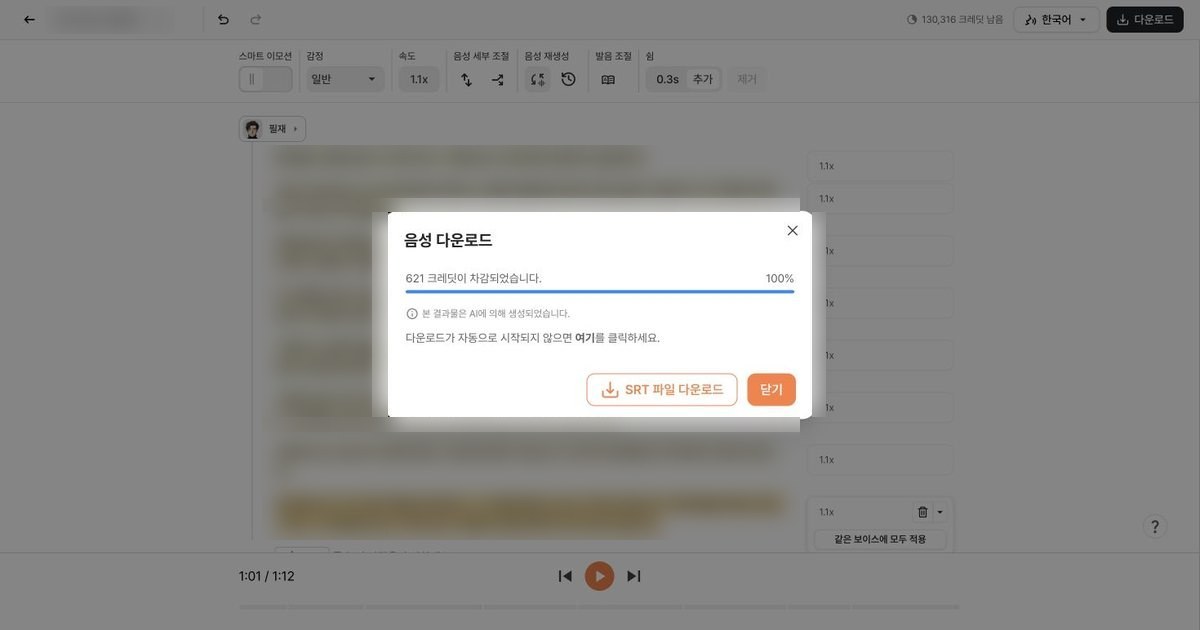
An AI text-to-speech service from Neosapience with a deep Korean voice library and per-sentence control of emotion, speed and sentence endings. We voiced our Korean AI shorts with it. Credits are spent only on download.
 OpenAI Whisper
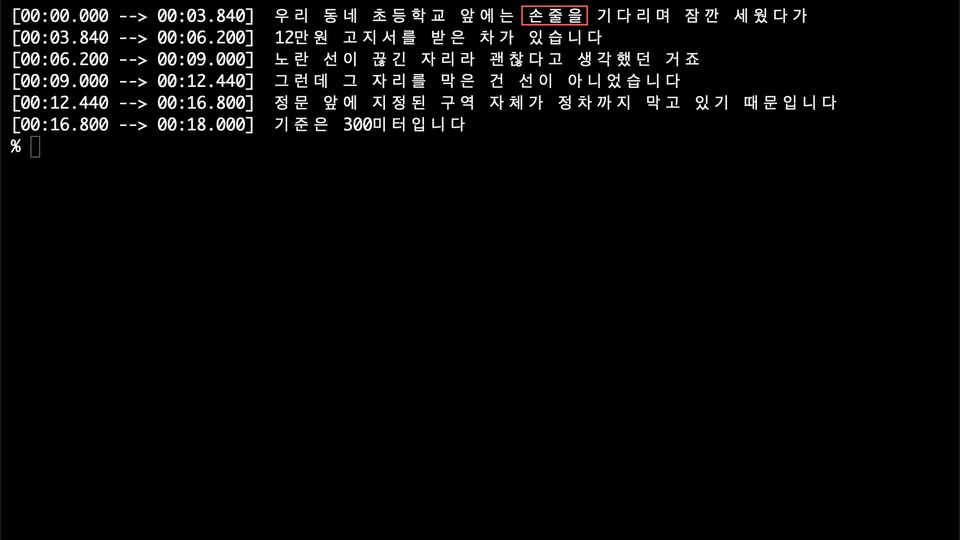
A speech recognition model whose code and weights OpenAI released under the MIT License. It runs free on your own computer. We use it to transcribe AI narration right after download and compare it against the script.
Logos and icons are trademarks of their companies, shown only to identify each tool. They do not imply affiliation or endorsement.
How we built this card
- We re-read the official product and pricing pages on 2026-11-07.
- For tools our desk uses, we record the plan, period and numbers; for tools we have not used, we say so.
- No star ratings. This page contains no affiliate links, and every external link goes to the official site.
Sources: QwenLM/Qwen3-TTS repository · Qwen3-TTS-12Hz-1.7B-CustomVoice model page · Qwen3-TTS LICENSE (Apache 2.0) · Alibaba Cloud Model Studio model pricing · Model Studio non-real-time speech synthesis · Model Studio free quota for new users · Model Studio Qwen-TTS voice list · mlx-audio (third-party Mac package) · 음성 · 오디오 AI 업계 지도(ko) · Voice and audio AI market map (en) · 편집부 글 듣기 샘플: 로봇 돈은 본체를 판 뒤에 갈린다(ko) · Our article audio sample: robotics market map (en)