AI Tools / OpenAI Whisper
Independent overview · No affiliate links
 OpenAI Whisper
A speech recognition model whose code and weights OpenAI released under the MIT License. It runs free on your own computer. We use it to transcribe AI narration right after download and compare it against the script.
Official site ↗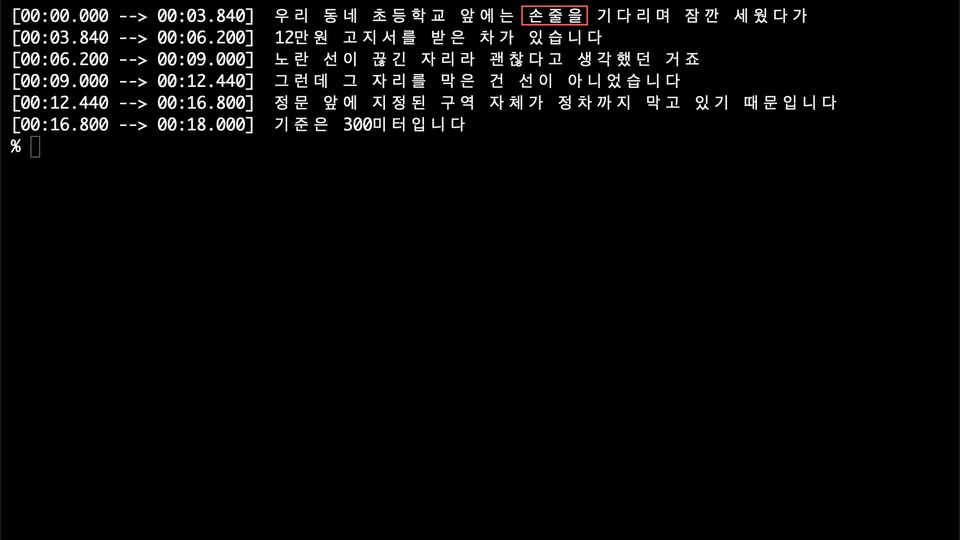
- Best known for
- Multilingual speech recognition on your own machine, with word timestamps
- Billing model
- The model itself is free; the cost is your hardware and time
- A 90-second short via API (our math)
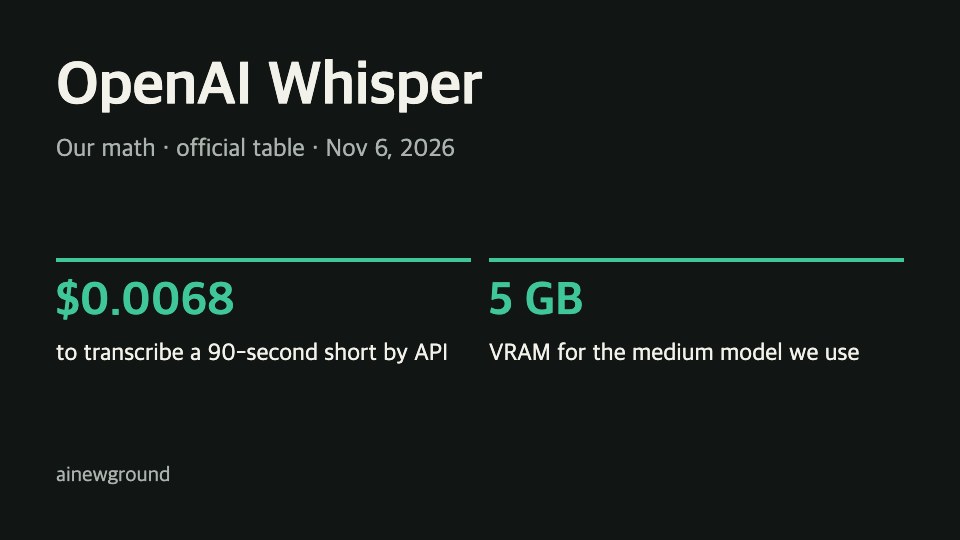
- About $0.0068 at gpt-transcribe's $0.0045 per minute
- Memory needed
- tiny and base ~1 GB · small 2 GB · medium 5 GB · turbo 6 GB · large 10 GB (official VRAM table)
- License
- MIT for both code and weights
- GitHub stars (2026-11-06)
- About 112,000
What this tool does
Whisper is something you download, not a service you sign up for. The name causes confusion because it covers two things: the open model in the repository, which runs on your computer, and the whisper-1 API model, which closes on 2027-02-26. The newest model on the model card is turbo, from September 2024, and the API's gpt-transcribe is a separate product that does not appear in the repository's table.
We treat it as a proofreader rather than a stenographer. In the latest checks on 10 English shorts, 277 of 307 narration sentences matched the script once numbers were spelled out on both sides. The other 30 were marked as differences, and 2 of those carried a number-difference flag. That is agreement between clean synthetic speech and a script, so do not read it as accuracy on real recordings with noise or several voices.
What you get is a cheap second pair of ears ahead of expensive production steps. The comparison itself uses no credits. The output is a list of places to listen, and a person decides what gets fixed.
Our hands-on notes
- We transcribe Typecast narration paragraph by paragraph right after download and compare it with the script, using the medium model with condition_on_previous_text=False.
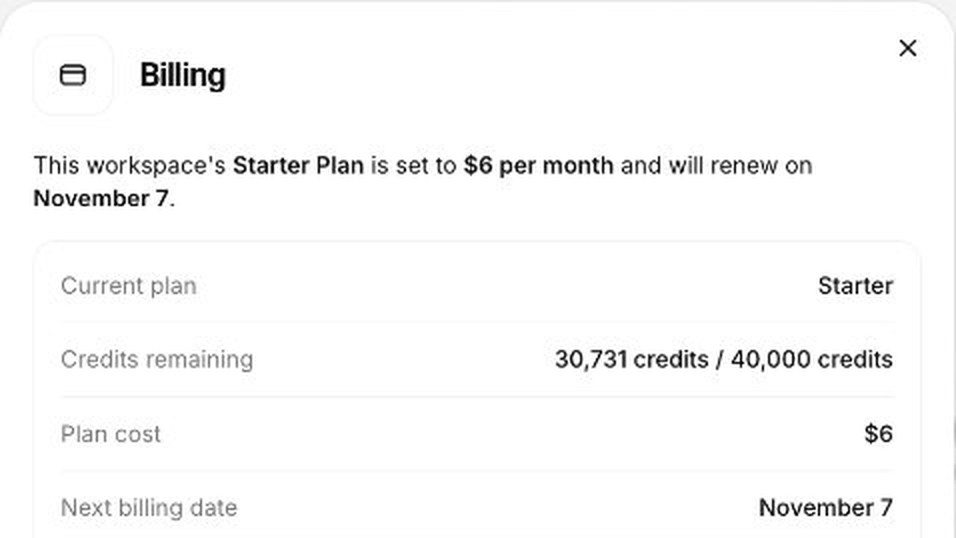
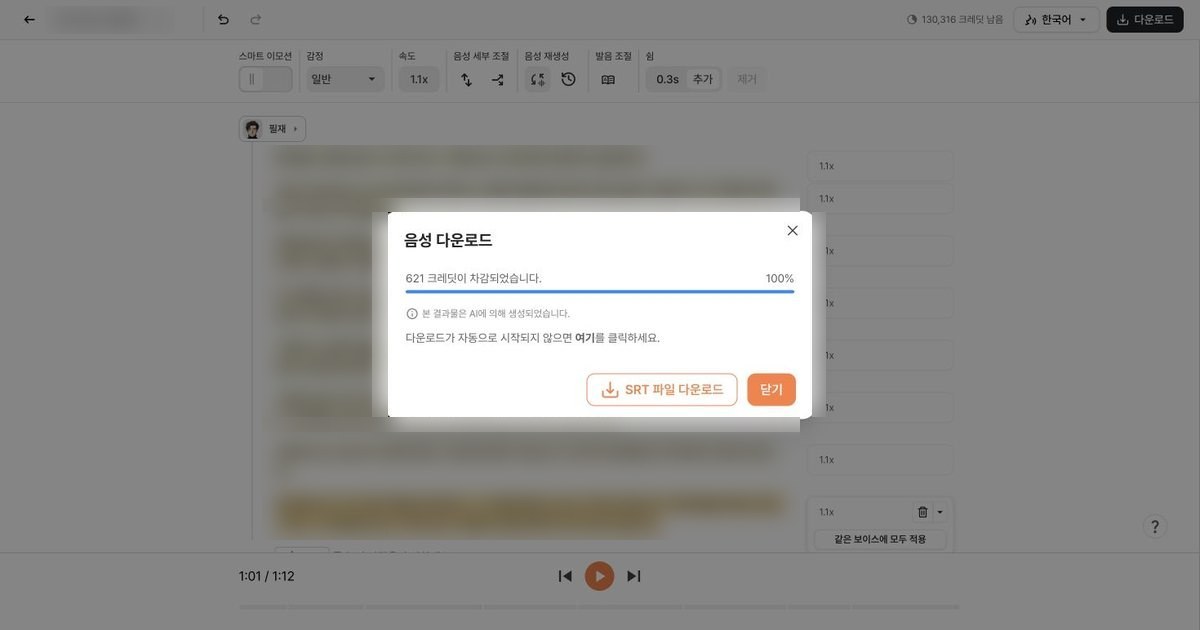
- Before this check, a narration swapped one sentence for a repeat of the previous one, and a person only caught it by ear after shot design and 720p production. Regeneration cost another 240 credits (2026-10-01).
- The same check caught a number read the wrong way in Korean. Only the corrected paragraphs were downloaded again, for 166 credits (2026-10-04).
- Do not trust word-end timestamps blindly for automated edits. Automatic speed correction driven by a wrong word end sped one phrase up by 1.6–1.8 times, so we removed that automation.
- Three sessions running medium at once all stalled for 25 minutes (2026-10-08), with the disk 97% full and memory exhausted. We now run one transcription at a time.
- Keep track of where the model and environment live. We once wrongly concluded it was not installed and reinstalled it in another folder (2026-10-14).
- Checked: on 2026-11-06 we re-read the repository README, model table and license, OpenAI's speech-to-text docs and the API pricing page.
- Not checked: Korean word error rate on our own material, the turbo and large models, and hosted prices from other companies such as Groq. Processing time varies by machine, so we do not quote one.
Who it fits
AI narration producers
With a finished script, you can find swapped sentences and misread numbers before shot design, at no credit cost.
Teams whose audio cannot leave
Files do not go to an outside API. Recording consent remains yours to handle, and the model card cautions against transcribing people without it.
Developers building batch jobs
MIT terms and a Python function let you embed it and re-run files with no meter. You write the queue that keeps runs from overlapping.
Subtitle makers with review time
One command produces draft SRT and VTT files. Proofreading is still a separate job.
Channels with two language tracks
We run Korean and English checks on the same medium model. Performance differs by language.
Who should skip it
- Live captions or meeting notes with speaker names: the model card says it cannot do real-time transcription out of the box, and the command line and transcribe function have no speaker option.
- Records that feed medical or legal decisions: the model card cautions against high-risk use and says output may include text that was never spoken.
- Anyone converting the occasional file: at about $0.27 per audio hour, the API costs less than the time spent setting up Python and ffmpeg.
Core features
Six model sizes
The command-line default is turbo. Omit --model and you get a model our records do not cover, so write the size into scripts.
Relative speed table
Measured on English speech on an A100 GPU, so it says little about a laptop. We run on CPU, which moves the memory load onto the system.
--task translate
Outputs English only. Turbo returns the original language even with this option, so use medium or large.
condition_on_previous_text
On by default. The code says turning it off can make text vary between windows but makes failure loops less likely. We turn it off for Korean paragraph checks.
initial_prompt
We pass place and personal names from the script. By default it reaches the first window only; carry_initial_prompt extends it but may weaken conditioning on earlier text.
word_timestamps
Off by default and labeled experimental in the help text. We use it to locate spots to listen to, and find lecture sentence boundaries from script character ratios instead.
Output formats
The default writes every format, so files pile up. Use -f to choose one. JSON holds the per-segment confidence values.
.en models
English-only versions exist from tiny to medium and are described as tending to do better. Our English check uses multilingual medium, so we have not measured the gap.
How we actually run it
Fix the inputs
For each synthesized file we set the language and the medium model and pass names from the script as a hint.
Transcribe narration alone
Never the mix. A mix with water and earth sounds misread at any level, so our buried-voice check moved to the narration track.
Normalize both sides
Korean drops spacing and punctuation. English spells out numbers on both sides and treats homophones such as won and one, or for and four, as equal.
Sort the differences
Notation gaps like 5 versus five get skipped. Only meaning changes are re-run on small, with and without the hint.
Hand over to a listener
A table lists minute and second, phrase, what the transcript heard and our call. Sometimes the transcript is wrong: when "205 won" appears as $205.1, we replay only the number.
Fix only what broke
A person listens and decides. Our 166-credit fix compares with about 980 for the full track. We splice at boundary silence and transcribe the new part again. If a word flips meaning, like razed heard as raised, the script changes.
Scan generated clips
Before assembly, small transcribes each Flow clip to find speech (no_speech_prob under 0.5, avg_logprob above −1.0). A person first heard English voice in 1 of 51 clips, which prompted this.
OpenAI Whisper pricing
Local (open source)
- Free code and weights; no usage cap
- Power, hardware and time are yours
Pricing checked 2026-11-06 · Official pricing page ↗
The Whisper repository has no plans. API prices for comparison were read from OpenAI's API pricing page on 2026-11-06 (gpt-transcribe $0.0045, gpt-4o-mini-transcribe $0.003, gpt-4o-transcribe $0.006 per minute). Converted figures use the exchange rate noted on this page.
Strengths
- MIT-licensed code and weights are simple to include in commercial products
- Audio stays on your machine
- No metered billing, so re-running a file costs no extra money
- Model size can match your hardware
- Multilingual transcription and translation run from a single command
- Word timestamps can help locate caption and edit points, with a person confirming automated decisions
What to consider
- It may not be the tool to pick to save money: a 90-second API transcription costs under one US cent, so 100 of them stay under $1. The local advantage is data control and repeat processing rather than cost.
- It uses more memory than you might expect. Medium needs about 5 GB of VRAM on the official table, and parallel runs can stall. Buying hardware for it reverses the cost comparison.
- The repository's Whisper and OpenAI's API speech models are separate paths. The API's whisper-1 and gpt-4o-transcribe family are due to shut down on 2027-02-26, so API code must move to gpt-transcribe.
- The API caps files at 25 MB. Long lectures or podcasts need splitting, and handling those boundaries is extra work.
- Performance varies widely by language, as the repository itself notes. Korean numbers and proper nouns still need a human comparison.
- A correct transcript does not prove correct pronunciation. Sound changes that flip the meaning may not show in the transcript, so someone still has to listen.
Alternatives
- ElevenLabs — Pick ElevenLabs Scribe v2 if you need speaker labels for up to 32 people and 3 GB files, at $0.22 per audio hour; audio leaves your machine.
- OpenAI API (gpt-transcribe) ↗ — Pick gpt-transcribe if you lack a suitable machine and transcribe occasionally: about $0.27 per audio hour, 25 MB per file, and the guide ties word timestamps to whisper-1.
FAQ
How much does Whisper cost?
As of 2026-11-06, Whisper in the public repository is free, with code and weights under MIT. The cost is your hardware. Without hardware, OpenAI's API charges $0.0045 per minute for gpt-transcribe and $0.003 for gpt-4o-mini-transcribe.
Is the free version allowed for commercial use?
The repository says code and weights are under the MIT License. Read the license text for conditions on commercial products. Rights in the audio you transcribe are a separate matter. This is not legal advice.
Which model should I choose?
The official table lists VRAM of about 1 GB for tiny and base, 2 GB for small, 5 GB for medium, 6 GB for turbo and 10 GB for large. We use medium for narration checks and have not compared accuracy with other models.
Is local or API cheaper?
With hardware already in place local adds almost no cost, but a 90-second API transcription is also under one cent, so the gap is small unless volume is very high. Choose local when audio must stay in-house or you re-run files often.
Is there anything to cancel or refund?
The repository version has no billing, so nothing to cancel or refund. The API is usage-billed under OpenAI's terms, which say payments are non-refundable except where the law requires. whisper-1 is due to shut down on 2027-02-26.
Can Korean transcription be trusted?
We have not measured its accuracy. It works well for spotting differences against a script, once spelling differences such as 5 and five are ignored. Without a script, plan on a person checking numbers and proper nouns.
How does it compare with other transcription tools?
Alternatives include ElevenLabs Scribe and hosted APIs. We have only used Whisper for transcript checks and never compared them on the same audio, so we do not rank them.
What should I check if transcription seems stuck?
Check for other transcription processes, free disk space and memory first. Our stall came from running three copies of the same model at once.
What order does our narration check follow?
Right after downloading a synthesized file, we transcribe it paragraph by paragraph with the medium model, turning off condition_on_previous_text so errors do not spread between paragraphs. We compare the text with the script, list the differences in a table and ignore spelling differences such as 5 and five. Only real misreadings get that paragraph downloaded again. Finishing this before the next production stage keeps regeneration cost small.
What do I need for a first install?
Per the repository, you need Python, PyTorch and the ffmpeg command-line tool. The first run downloads the model file; the medium file we use is about 1.5 GB. Writing down the environment and model path saves you from installing it twice.
What happens to whisper-1 on the API?
OpenAI's docs say whisper-1 and the gpt-4o-transcribe family are due to shut down on 2027-02-26, and recommend gpt-transcribe for recorded speech. That schedule concerns the API; the public repository version you download is separate. Check the repository itself for model updates.
Our verdict
Install it if you have a script to compare against or audio that cannot leave, and you repeat runs regularly. One sentence found late cost us 240 credits, and the comparison itself costs none. Pass on it if you want transcripts with no human review, live captions or speaker labels. An audio hour costs about $0.27 on gpt-transcribe or $0.22 on Scribe v2, which beats the setup time. If you are moving API code, OpenAI's guide ties word timestamps to whisper-1, so check any timing-dependent work first. Read the transcript as a list of places to listen, not as a final ruling on the audio.
Similar tools
 ElevenLabs
A US/UK voice AI company. Multilingual TTS, voice cloning, dubbing, sound effects and voice agents all draw on one shared credit pool. We used it to voice the English versions of our shorts.
 Qwen3-TTS
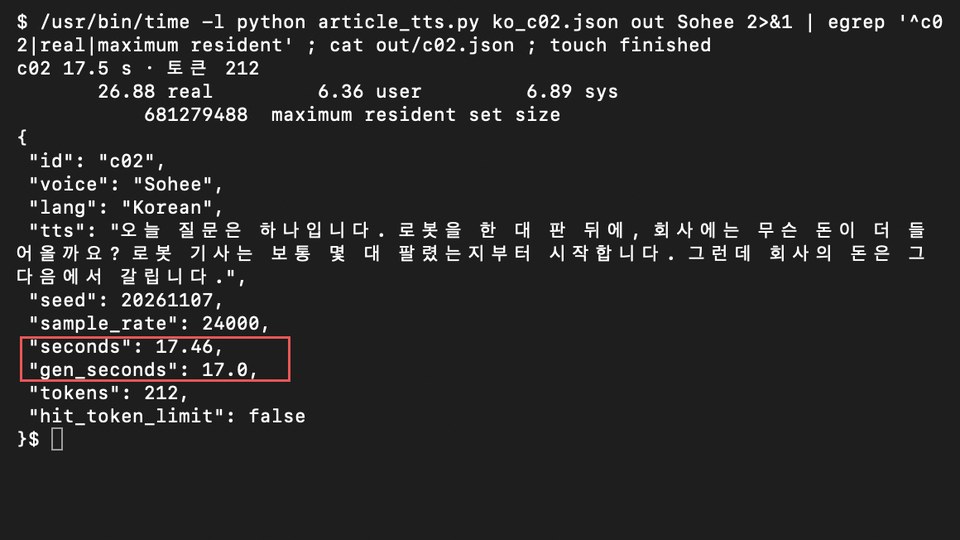
A speech synthesis model the Qwen team at Alibaba released under Apache 2.0. Run locally it has no fee, and the cost is your hardware and time. We use it on a Mac for the four-language audio of our robotics article and for course narration.
 Typecast
An AI text-to-speech service from Neosapience with a deep Korean voice library and per-sentence control of emotion, speed and sentence endings. We voiced our Korean AI shorts with it. Credits are spent only on download.
Logos and icons are trademarks of their companies, shown only to identify each tool. They do not imply affiliation or endorsement.
How we built this card
- We re-read the official product and pricing pages on 2026-11-06.
- For tools our desk uses, we record the plan, period and numbers; for tools we have not used, we say so.
- No star ratings. This page contains no affiliate links, and every external link goes to the official site.
Sources: openai/whisper repository · Whisper model card · Whisper LICENSE (MIT) · OpenAI speech to text guide · OpenAI API pricing · 음성 · 오디오 AI 업계 지도(ko) · Voice and audio AI market map (en) · Whisper transcribe.py (command-line options) · ElevenLabs speech to text documentation · ElevenLabs API pricing